In Living in Both Worlds: Modern Orthodox Judaism in the United States, 1945–2025, Dr. Lawrence Grossman has written a fantastic book that looks at the development of modern orthodoxy in the USA. He writes that many practices in the modern Orthodox world that were perfectly acceptable then are now verboten. From the consumption of non-glatt meat, women not covering their hair, to mixed dancing and more, are things of the past in today’s modern orthodoxy.
Professor Haym Soloveitchik’s 1994 essay Rupture and Reconstruction: The Transformation of Modern Orthodoxy brilliantly articulates the shift in practice from a mimetic tradition (learned by example) to a stricter, text-based observance. Soloveitchik wrote that the Holocaust broke familial transmission and forced people to rely on detailed halakhic texts for guidance, leading to increased ritual stringency.
Between what Grossman and Soloveitchik wrote, it’s pretty shocking to find that swaths of ultra-orthodox Jews engage in idolatrous practices, in the name of new age practice and alternative medicine therapies.
“You shall live by them,” as written in Vayikra 18:5, is a central tenet in Judaism. One of the things one must forfeit one’s life rather than live by is idolatry. The tragic era of the Crusades is filled with incidents where thousands of Jews had to do just that.
With the move to the right and it being axiomatic that one has to forfeit their life rather than engage in idolatry, it’s quite shocking to read magazines from the most right-wing communities that have advertisements for techniques and classes which, at worst, are actual idolatry, and at best, at least a question of it. Which, in the current era, would automatically forbid such practices. This includes alternative medicine practices, new age therapies, and the like, that at best may be nothing more than a placebo, and at worst, actual idolatry.
In 2017, Rabbi Rephoel Szmerla wrote Alternative Medicine in Halachah. I wrote my objections to the book, The Not-So-Orthodox Embrace of the New Age Movement, for The Lehrhaus.
Betteridge’s law of headlines is an adage that states “Any headline that ends in a question mark can be answered by the word no.” It is based on the assumption that if the publishers were confident the answer was yes, they would have presented it as an assertion; by presenting it as a question, they are not accountable for its correctness.
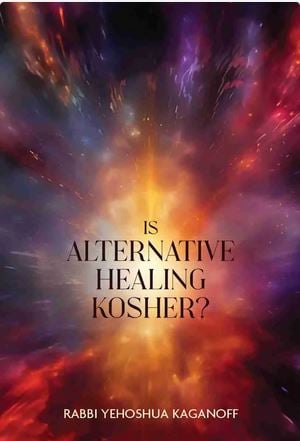
Betteridge applies to Is Alternative Healing Kosher? (Mosaica Press) by Rabbi Yehoshua Kaganoff. The book is Kaganoff’s scholarly response to Szmerla’s book.
Many scholars have written particularly acerbic responses to their interlocutors, from the Raavad against the Rambam, to Professor Haym Soloveitchik and beyond. Here, Kaganoff takes a very gentle (I would say far too gentle) approach to countering Szmerla, even though, at face value, Szmerla would be allowing idolatrous practices for the masses.
Rav Reuven Feinstein, who wrote a haskama for the book, noted that there is great confusion in the Orthodox community regarding the propriety of alternative medical treatments due to unfamiliarity with their origins and unawareness of the major halachic concerns they raise.
Rabbi Aryeh Lebowitz similarly noted that when he first began investigating the halachic propriety of yoga, he conducted his own research in addition to speaking with leading poskim to reach a reasonable conclusion on how to deal with it halakhically. But when he tried to talk with these rabbis about yoga, most of them were not familiar with what he was talking about.
Kaganoff’s book is an essential reference that articulately details the myriad serious halachic problems with alternative medicine. It’s important to note, as Kaganoff does, that the term “alternative medicine” is quite broad and somewhat fluid, so that not every alternative medicine practice is prohibited according to Halacha.
Alternative medicine is an outgrowth of the New Age movement. The movement’s acceptance of occult practices, pantheism, and a “spirituality without borders or confining dogmas that is inclusive and pluralistic” is anathema to Halachas. Rabbi Szmerla’s book reflects a trend within some parts of the Orthodox Right to eschew modern science and contemporary medicine.
Szmerla’s worldview leads him to promulgate bad science while misrepresenting Chazal. The danger with his book is that he oversimplifies both Halacha and the often complex fields of science and medicine. This leads to his acquiescence to therapies that other major poskim outright forbid. What is disturbing in this book is the underlying trend it illustrates.
While Rabbi Aryeh Lebowitz noted that leading rabbis were not familiar with what he was talking about, Kaganoff writes that this is not a new problem. Rashba and 18th-century Rabbi Moshe Chaviv (Maharam Chaviv), who did not have access to the Arabic original of the Moreh Nevuchim, relied on translations that had errors. Moreh Nevuchim was a critical reference they relied on, and its translations have often been problematic.
From a semicolon invalidating an election because it created ambiguity, to a class-action lawsuit about overtime pay for truck drivers hinging entirely on an Oxford comma, punctuation and definition of terms has significant implications. Kaganoff spends a lot of time defining specific terms, especially those whose meaning has changed over the years. This is critical as these terms are central to the debate around alternative medicine.
If the problem of alternative medicine is so significant as Kaganoff writes, why have there not been mass protestations and kol korehs against it? History has shown that many protests often have their roots in politics and power struggles, and there is not much of them around alternative medicine.
For example, Processor Motti Inbari writes in Ruth Blau: A Life of Paradox and Purpose that when Rabbi Amram Blau wanted to marry Ruth Ben-David, her marriage to Blau was protested against by the Edah HaChareidis. The proposed marriage allowed the leadership of the Edah HaChareidis to settle old scores with Blau and remove him from power.
The Slifkin affair of 2006 and the current controversy over a marriage annulment have much less to do with Toras Emes and much more to do with power, politics, and enmity against certain rabbinic families.
When it comes to alternative medicine, its proponents are much more numerous than its dissenters. The proponents will go to rabbis who endorse alternative medicine and have been misled by them through misrepresentations or misinformation, especially in topics where they do not, not unexpectedly, have the proper grounding or background. The confluence of these deficiencies precipitated the misapplication of halachic principles, which allow alternative medicine.
In the book, Kaganoff details many pseudoscientific practices, such as applied kinesiology, magnetic therapy, dowsing, Mesmerism, and more, and the serious halachic problems associated with them.
The ability to discern real science from pseudoscience is not a trivial endeavor. With so much misinformation on TikTok and other social media channels, distinguishing between what is real and what is snake oil is a challenge. The book offers the following six ways to avoid falling victim to pseudoscientific medical claims:
Check the source – is it from a reputable source, such as a peer-reviewed journal or a mainstream news site?
Qualifications – Is the writer from a university or a reputable institution? Where is their accreditation? Or are they an independent researcher with no (or dubious/spurious) accreditation?
Who else agrees? – Can you find other accredited experts from mainstream institutions who agree, or at least provide some validity? Such experts can be found on websites such as the Mayo Clinic, National Institutes of Health, and PubMed. Concerning cancer treatments (where pseudoscience abounds), Memorial Sloan Kettering Cancer Center and the American Cancer Society are excellent resources.
References – has the writer done their research and cited other credible research to support their results?
Follow the logic – are they cherry-picking evidence, leaving things out to suit their narrative? Become an expert – if all else fails, and you’re still not sure, then do a bit of open-minded reading on the subject to make sure you’re not being misled. Read both sides of the argument.
As we approach December 25, no observant Jew would entertain the thought of having a Christmas tree in their home. But certain new-age practices and alternative medicine practices are akin to that.
Kaganoff has written an extremely important book on the topic. And when people look back in 50 years, they will wonder in disbelief how observant Jews could have ever embraced new age therapies and idolatrous alternative medicine practices.
link