Sample
The sample of participants used in this experiment is based on a previous sample collected through NetQuest, a panel provider operating in Peru, to be representative of the general population in terms of age, gender, and region. This previous study constitutes a comprehensive mixed-methods examination of psychosocial predictors, attitudes, and spontaneous usage reasons (using open-ended questions) of CAM in Peru31. With the exception of the usage reasons, the pre-test measures of the present experiment were taken from the previous study. For this experiment, after two weeks we recontacted 353 participants who had indicated medium to high levels of belief in the effectiveness of egg cleanse in a previous study (i.e., responses of 4, 5, 6, or 7 on a 1–7 Likert scale). To ensure that the initial level of belief was evenly distributed across the three experimental conditions, participants were randomly assigned to each group using a stratified randomization procedure based on their pretest belief scores. This procedure ensured a balanced representation of participants with scores of 4, 5, 6, and 7 across groups, without requiring exactly equal numbers in each score. A total of 167 participants completed the experiment and passed both attention checks. Of these, 52 were assigned to the tailored debunk group, 56 to the non-tailored debunk group, and 59 to the control group. The sociodemographic characteristics of the sample are displayed in Table S1. Given our sample size, the critical values for detecting group differences at α = 0.05 (two-tailed) are approximately F(2, 164) = 3.90 and t = 1.98 (α = 0.05, two-tailed).
Measures
Usage reasons (administered before and after the experimental manipulation): Following a previous psychological classification of anti-vaccination arguments10,32,33, used in similar experiments addressing vaccine hesitancy9, we developed a psychological classification of common arguments in favor of CAM techniques, such as egg cleanse, based on a prior comprehensive systematic review20, which covered preference for a holistic approach to health, preference for natural products and treatments, distrust in conventional medicine, benefits of egg cleanse, reliance on positive testimonies, reliance on personal intuition, ideological traditionalism, and alignment with personal conceptions of spirituality. Participants indicated agreement with each of these usage reasons using a Likert scale of 1 to 7 (1 = Strongly disagree, 7 = Strongly agree). Exploratory factor analyses (EFA) using maximum likelihood estimation and parallel analysis resulted in reliable unidimensional structures in both the pre-test (factor loadings > 0.35, α = 0.78) and post-test (factor loadings > 0.42, α = 0.84). Both usage reasons assessments included an attention check worded “This is an attention check. Please select answer X”, with X being 3 in one of the questionnaires and 6 in the other.
We also assessed three attitudinal variables in relation to egg cleanse as well as other examples of CAM known to be present in Peru (belief in effectiveness, future use, and preference over conventional medicine), using a pre-test obtained from a previous study and a post-test administered after the experimental manipulation. Exploratory factor analyses using maximum likelihood estimation conducted at pre- and post-test stages showed non-convergent solutions and inconsistent communalities, indicating that the items did not load onto a single latent factor. Internal consistency analyses also supported this conclusion, yielding low reliability at pre-test (α = 0.55) and moderate reliability at post-test (α = 0.73). These results suggest that the three items capture conceptually distinct yet related aspects of attitudes toward egg cleanse, and were therefore analyzed separately rather than combined into a composite score.
-
1.
Belief in effectiveness. Participants indicated whether they believed in the effectiveness of egg cleanse for the diagnosis and/or treatment of any disease using a single 1–7 Likert scale (1 = Not effective at all, 7 = Totally effective).
-
2.
Future use. Participants indicated whether they would use egg cleanse in the future for the diagnosis and/or treatment of any disease using a single 1–7 Likert scale (1 = Definitely would not use, 7 = Definitely would use).
-
3.
Preference over medicine. Participants indicated whether they preferred the use of egg cleanse over the use of conventional medical treatments using a single 1–7 Likert scale (1 = Prefer this technique, 7 = Prefer conventional medicine).
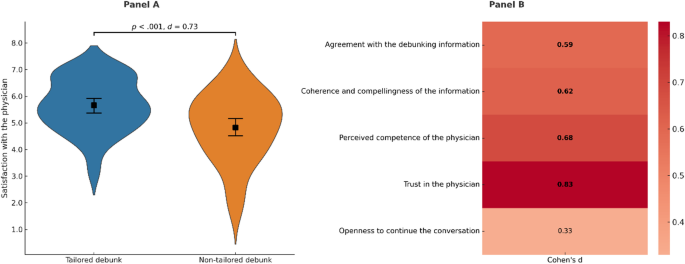
Satisfaction with the physician (administered in the two experimental groups after the post-test measures) consisted of five items measuring various aspects of satisfaction with the interaction with the physician: agreement with the debunking information received from the physician, coherence and compellingness of the information received from the physician, perceived competence of the physician, trust in the physician, and openness to continue the conversation. Participants indicated their satisfaction using a Likert scale from 1 to 7. EFA using maximum likelihood estimation resulted in a reliable unidimensional structure, with factor loadings > 0.69 and α = 0.89.
The complete wording and descriptive statistics of the questionnaire used in the experiment can be found in tables S2, S3, and S4.
Procedure
All experimental materials were text-based and presented on-screen within the online survey platform. Participants read the materials at their own pace and proceeded to the next screen once they had finished. The debunking messages followed the same affirmation–refutation structure and were comparable in length (160–190 words) and tone, using consistent empathic language across conditions. To standardize the format across groups, the non-tailored debunk was presented in two separate screens, matching the structure of the tailored condition. This ensures that any differences in outcomes can be attributed to tailoring rather than to wording or presentation differences. The debunking information was delivered in writing in both experimental groups by Dr. Pérez, a female fictitious physician. No picture or other graphical material was used. The physician was introduced in the first person through written text, self-identifying by her surname and professional title (“Hello! I’m Dr. Pérez. I would like us to talk about the reasons why you think egg cleanse is effective”). All affirmations and debunks used in the experiment can be found in Table S4.
After indicating their endorsement of all usage reasons using 1 to 7 Likert scales, participants in the three groups dichotomously selected their two preferred reasons for using egg cleanse (the number of times each usage reason was preferred can be found in Table S5). Participants in the tailored debunk group were exposed to affirmations and debunks specifically designed for their respective two preferred usage reasons. These tailored debunks were developed following the structure of the Empathetic Refutational Interview (ERI)9,34. In this framework, refutations are constructed as a collaborative dialogue between communicator and recipient, avoiding explicit appeals to external studies or epistemic authorities35. Our materials included only the empathic and reasoning-based stages of the ERI (Steps 1–3; “eliciting concerns”, “affirm”, and “offer a tailored refutation”), without progressing to Step 4 (“provide factual information”), which introduces empirical evidence and appeals to specific scientific publications if prior dialogue fails to promote understanding. The debunks used within the framework of the ERI were co-developed and refined in collaboration with healthcare professionals through the EU Horizon 2020 JITSUVAX project34,36,37. This previous experience informed the debunks used in this study to enhance their ecological validity.
For example, a participant who selected benefits and safety of egg cleanse and ideological traditionalism as their two most supported reasons would have first been exposed to a screen displaying a tailored debunk for benefits and safety of egg cleanse, comprised of the following affirmation and refutational message:
“It is normal to have questions and doubts about medical treatments and how they can affect us. We would all like medical treatments to be effective for everyone and in all conditions, but they cannot be guaranteed, like any other product, to be 100% safe and effective. Sometimes it is difficult to face uncertainty, so fear and rejection are perfectly understandable. Many people turn to alternative and traditional medicine without negative consequences, and many of these alternative remedies are presented as safer and more natural than conventional medical treatments.
The potential lack of side effects of egg cleanse is not because it is a better treatment, but because it has not been proven to actually have a real therapeutic effect on our body. Since a medical intervention, with a real effect on our body, can always have side effects, unlike egg cleanse, medical treatments undergo strict safety controls. Even though approved medical treatments are not 100% effective, they are approved because their benefits far outweigh any potential adverse effects. Moreover, if we wait to be absolutely certain of safety, we would never do anything in life. Imagine if we refused to get into a car unless the driver could prove 100% that we would not have an accident. Public health institutions and independent researchers have very reliable monitoring systems in place to track all possible side effects of drugs and other medical interventions, using statistics and taking into account many potential causes. However, we are often unaware of the effects and how responsibly egg cleanse is applied.”
Subsequently, the participant would have been exposed to a second screen displaying the following affirmation and refutational message for ideological traditionalism:
“Many of our traditions shape and give meaning to the way we act and identify ourselves, so they are part of who we are. People have the right to have their traditions taken into account by health professionals and to be treated with respect regardless of their cultural origin. In general, it is a positive thing to have appreciation for one’s own culture, since it helps to preserve and develop it.
Practices that can be considered traditional, such as egg cleanse, do not have evidence of effectiveness when tested using rigorous scientific methods. Therefore, the use of egg cleanse, although it may seem old, can prevent us from receiving truly effective treatment, or deviate us from a healthy lifestyle by confusing the real origin of diseases. Having a lifestyle based on cultural traditions does not in any way imply endangering our lives and those of others, especially those who belong to risk groups or who have other traditions. Furthermore, just because egg cleanse is presented as something ancient or traditional does not mean that it is good for us or our societies to continue practicing it. Traditions are not sacred, unchangeable, immutable or good in themselves; they are constantly changing to suit our needs and ethical principles. Think of all the traditions that have changed throughout our lifetime in favor of healthier practices (for example, smoking in front of children or driving without a seat belt). We must keep ourselves alive if we want, in turn, to keep our traditions alive.”
In contrast, all participants assigned to the non-tailored debunk group received the same debunk, with no affirmation, regardless of their preferred usage reasons. This general, non-tailored debunk was based on general issues such as the lack of scientific evidence supporting the clinical effectiveness of egg cleanse, the lack of professional regulation and quality control of practitioners of egg cleanse, or the possibility that alternative health beliefs related to egg cleanse negatively affect our decision making on healthy lifestyle and therapeutic opportunities:
“Alternative medicine techniques such as egg cleanse have not been proven effective for treating diseases and therefore should not be used as a treatment. A lot of effort has been put into studying these types of practices and their effectiveness has never been conclusively proven, using the best tools available for scientific research. Because of this, doctors should not recommend their use, instead recommending treatments that have been proven effective. In addition, people may confuse the real origin of their disease, which can lead to unhealthy lifestyles, as well as losing the opportunity to receive effective treatment to treat their disease. Another thing that can happen is that the person administering egg cleanse, who is usually not a registered and controlled doctor, commits some negligent practice that causes additional damage to the disease itself. Because of all this, I do not recommend using egg cleanse to treat diseases.
The use of alternative medicine techniques such as egg cleanse is not recommended by medical associations and scientifically endorsed treatment guides, since we do not have evidence to support its use. On the other hand, the potential dangers of techniques such as egg cleanse are well documented, since they can generate distorted ideas regarding the origin and treatment of diseases, as well as cause patients not to use treatments that are endorsed. Medicine is a science that develops at great speed and that has very powerful tools to generate knowledge and develop treatments that work. Alternative medicine such as egg cleanse, on the other hand, does not have evidence and, consequently, its use for the treatment of diseases is not recommended from a medical point of view.”
link